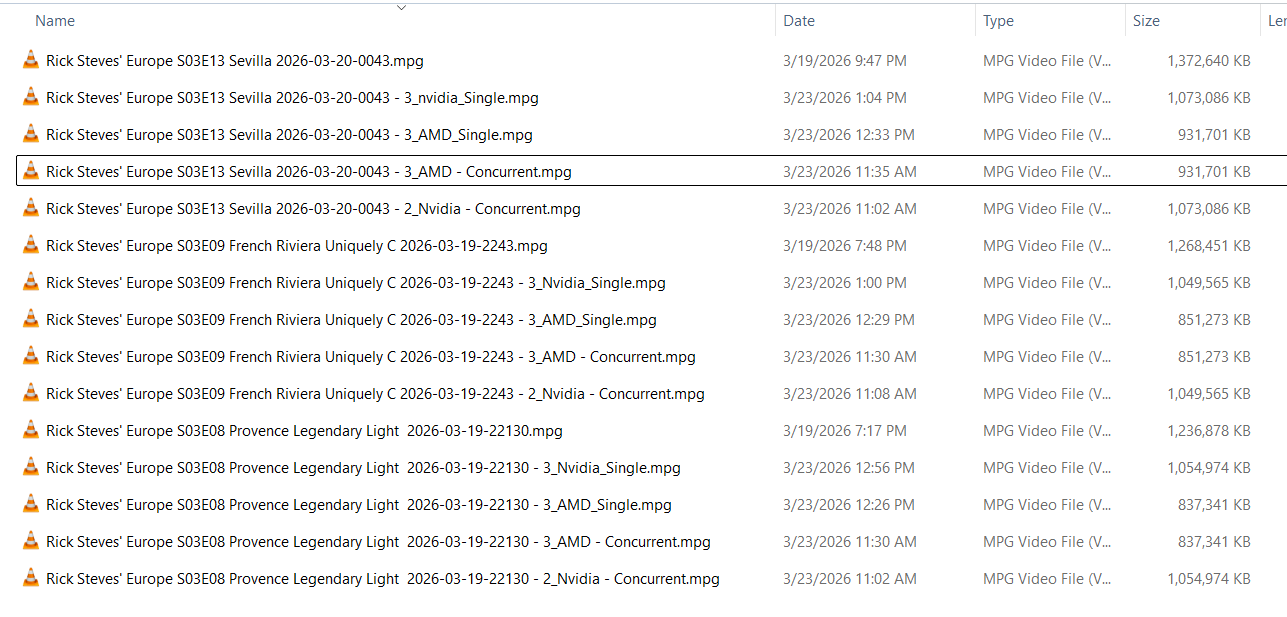
Hi, I recently added an older RTX 3070 TI graphics card to my PC (using external PCIE slot with oculink). I was under the impression that I could do more concurrent streams with that than the built in AMD 780M in my NUC.
I noticed that the AMD was having better results using the same profile (HEVC Mp4 but saving as MPG file) than the NVidia. I ran several tests and same thing happened regardless if it was single encoding or multiple encodings happening concurrently.
Curious why the AMD would show such better results than the Nvidia when not using Av1 codecs?
It’s very common to see different file sizes when comparing hardware encoders like NVIDIA (NVENC) and AMD (AMF), even when using the exact same profile. This happens because hardware encoders are physically different chips on your GPU, each with its own proprietary algorithms for how they handle video compression.
Here are a few reasons why you are seeing those differences:
1. Different Encoder Implementation
NVIDIA and AMD use different “rate control” logic. When MCEBuddy passes a command (like a target bitrate or quality level), the NVIDIA chip and the AMD chip interpret that instruction differently. In many cases, AMD’s HEVC encoder aims for a more aggressive compression by default, or handles “Constant Quality” (CRF/QP) scales differently than NVIDIA.
2. Efficiency vs. Quality
Just because a file is smaller doesn’t necessarily mean it’s “better.” It usually means it has a lower bitrate. You might want to check for:
Visual Artifacts: At the same size, one might look blockier than the other.
Speed: NVIDIA’s RTX 3070 Ti is generally much faster at encoding than the integrated 780M, which is often the trade-off for the slightly larger file size.